A leading two-wheeler manufacturer was looking to improve the quality and consistency of its end-of-line vehicle inspection process. Every scooter produced on the assembly line was required to undergo a comprehensive functional inspection before dispatch, ensuring that all electrical and safety-critical components operated correctly. As production volumes increased, the manufacturer found it increasingly difficult to maintain consistent inspection quality using traditional manual methods.
The company partnered with Citriot to develop an AI-powered automated inspection solution capable of performing standardized, repeatable, and fully traceable quality checks without relying on operator judgement. The solution was implemented using *Cognivision*, Citriot's intelligent computer vision platform for manufacturing quality inspection.
At the final stage of the manufacturing process, every assembled scooter had to be inspected to verify the correct operation of multiple electrical and functional components. These included the headlamp, high and low beam, front and rear indicators, tail lamp, brake lamp, horn, instrument cluster, speedometer, warning indicators, and other dashboard functions.
The inspection process was performed manually by operators who visually checked every component while simultaneously recording the inspection results. Although effective for low production volumes, the process became increasingly difficult to manage as manufacturing capacity expanded.
The manufacturer encountered several operational challenges. Inspection quality varied between operators and production shifts, resulting in inconsistent quality standards across the plant. Manual inspections also increased overall inspection time, limiting production throughput. Operator fatigue during repetitive inspections occasionally led to missed defects, while the absence of digital evidence made it difficult to investigate customer complaints or perform quality audits. The company required a solution that could standardize inspections, eliminate subjectivity, improve traceability, and support higher production volumes without compromising quality.
Citriot designed and deployed an intelligent inspection station powered by *Cognivision*, integrating industrial vision systems, AI-powered image analysis, sensor synchronization, and automated quality validation.
The inspection station was equipped with multiple industrial-grade cameras positioned to monitor the front, rear, and dashboard areas of every scooter. High-resolution cameras continuously observed lighting components, while dedicated dashboard cameras monitored the instrument cluster, warning indicators, and speedometer responses. Industrial microphones were installed to verify horn activation through real-time audio analysis.
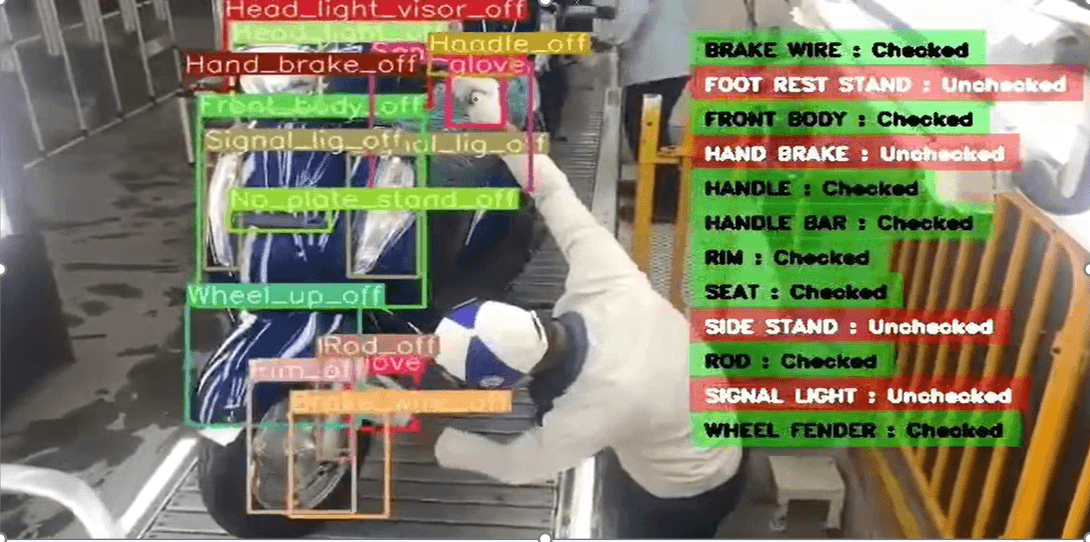
As each scooter arrived at the inspection station, the inspection sequence started automatically. The operator simply followed a guided workflow by activating the required vehicle controls, including the headlight switch, turn indicators, brake lever, and horn. Throughout the inspection, Cognivision continuously analysed video streams and sensor inputs to validate every inspection step in real time.
Rather than simply recording video, the AI engine interpreted every inspection event. It verified that headlights illuminated with the correct intensity, confirmed high and low beam operation, validated indicator blinking patterns, detected brake light activation, monitored dashboard warning indicators, verified speedometer response, and confirmed horn activation through synchronized audio analysis. Every inspection step was automatically compared against predefined quality standards, eliminating the need for subjective operator decisions.
The project was executed in multiple stages to ensure seamless integration with the existing production line while avoiding disruption to manufacturing operations.
The first stage involved studying the customer's assembly process and identifying every quality checkpoint performed during the end-of-line inspection. Citriot engineers worked closely with the quality assurance team to define standardized inspection criteria for each electrical and functional component.
The second stage involved installing multiple industrial cameras and audio sensors around the inspection station to provide complete visibility of the vehicle from every required angle. Camera placement was carefully optimized to eliminate blind spots while ensuring reliable inspection regardless of vehicle positioning.
Once the hardware infrastructure was deployed, Cognivision was trained using thousands of inspection samples collected from correctly assembled vehicles. These datasets enabled the AI models to accurately recognize normal operating behaviour and distinguish genuine defects from acceptable manufacturing variations.
After model validation, the system was integrated into the production workflow. Every scooter entering the inspection station was automatically identified, and the inspection sequence began without requiring manual configuration. The AI continuously analysed each inspection event, generated pass or fail decisions in real time, and recorded inspection evidence including images, timestamps, detected defects, and operator information.
The inspection reports were automatically stored in a centralized database, providing complete digital traceability for every manufactured vehicle and enabling faster quality audits and root cause analysis.
Following the deployment of Cognivision, the manufacturer significantly improved the efficiency and consistency of its end-of-line inspection process. Inspection times were reduced considerably while maintaining uniform quality standards across all production shifts.
The automated inspection process eliminated subjective operator judgement and ensured that every scooter underwent the same standardized validation procedure. Assembly defects that were previously overlooked during manual inspections were identified immediately, allowing corrective action before vehicles left the production facility.
The organization also gained complete digital traceability for every inspected vehicle. High-resolution inspection images, AI validation results, timestamps, and inspection records were securely stored, enabling faster warranty investigations, improved quality reporting, and simplified compliance with manufacturing standards.
The implementation of Cognivision transformed the manufacturer's quality assurance process from manual inspection to AI-driven automated validation. Inspection accuracy improved significantly while reducing inspection cycle time and increasing production throughput.
The organization achieved standardized inspection quality across all operators and production shifts, reduced rework and warranty claims, improved first-pass quality, and strengthened customer confidence by ensuring every vehicle met the same quality standards before leaving the factory.
With complete digital inspection records and real-time AI validation, the manufacturer established a scalable, data-driven quality control process capable of supporting future production expansion while maintaining consistent product quality.
This project demonstrates how Artificial Intelligence, industrial vision systems, and sensor fusion can modernize manufacturing quality assurance. By automating complex end-of-line inspections through Cognivision, Citriot enabled the manufacturer to improve inspection accuracy, increase production efficiency, eliminate subjective decision-making, and establish a fully traceable digital quality assurance process for every vehicle produced.