A leading manufacturing company operating multiple production lines depended on high-capacity motor pumps for critical industrial processes. These pumps operated continuously for long hours, making them one of the most important assets on the shop floor. Even a single unexpected motor pump failure could stop an entire production line, resulting in production delays, emergency maintenance, increased operational costs, and significant revenue loss.
The customer was following a preventive maintenance strategy where equipment was serviced after fixed intervals regardless of its actual condition. While this reduced some failures, it also resulted in unnecessary maintenance activities, increased spare-part consumption, and still failed to prevent sudden breakdowns that occurred between maintenance cycles.
To overcome these challenges, the customer partnered with Citriot to implement an AI-powered predictive maintenance solution capable of continuously monitoring machine health and identifying equipment degradation before failure occurred.
During the initial assessment, Citriot engineers analyzed the customer's maintenance records and production history. The analysis revealed that most breakdowns were caused by gradual mechanical degradation rather than sudden failures. Components such as bearings, shafts, couplings, and impellers showed early warning signs through abnormal vibration, increasing operating temperature, and changes in acoustic patterns. However, these symptoms were almost impossible to identify during periodic manual inspections.
The maintenance team relied heavily on operator observations and scheduled inspections, meaning that developing faults often remained unnoticed until the equipment reached a critical failure stage. This resulted in frequent emergency shutdowns, unplanned maintenance, production losses, and excessive repair costs.
The customer required a solution that could continuously monitor equipment health, automatically detect abnormal behaviour, and provide maintenance teams with sufficient time to schedule repairs before production was affected.
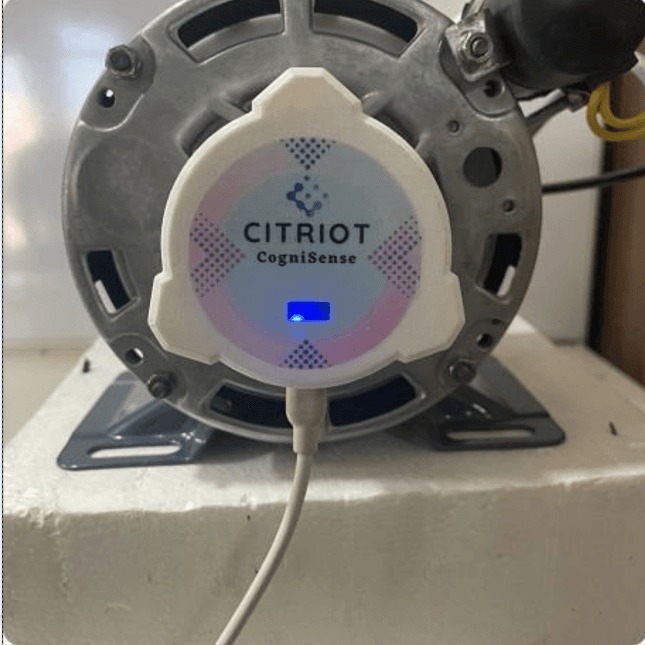
Citriot deployed its AI-powered predictive maintenance platform, *CogniSense*, across the customer's critical motor pumps. Industrial-grade IoT sensors were mounted directly on each machine to continuously capture vibration, surface temperature, and acoustic signals while the equipment was operating.
Instead of simply collecting raw sensor values, CogniSense processed the data locally using edge computing and securely transmitted it to the cloud for advanced analytics. During the initial learning period, the AI engine established a unique operating baseline for every motor pump by understanding its normal vibration signature, operating temperature, and acoustic behaviour under different production loads.
Once the baseline was established, every new sensor reading was continuously compared against expected operating conditions. The AI models automatically identified deviations that indicated bearing wear, shaft misalignment, rotor imbalance, cavitation, overheating, lubrication issues, or other developing mechanical faults.
Rather than waiting for equipment failure, CogniSense generated intelligent alerts as soon as abnormal patterns exceeded predefined thresholds. The platform also estimated Remaining Useful Life (RUL), calculated Mean Time Between Failures (MTBF), and assigned a health score to every asset, enabling maintenance engineers to prioritize repairs based on actual equipment condition instead of fixed maintenance schedules.
To simplify decision-making, an integrated Large Language Model (LLM) converted complex sensor analytics into easy-to-understand maintenance recommendations. Instead of interpreting graphs and vibration spectra manually, engineers received clear explanations describing the detected fault, its likely cause, the severity level, and the recommended corrective action.
The project was executed in multiple phases to ensure smooth deployment without disrupting production operations.
The first phase involved identifying all critical motor pumps whose failure had the highest impact on production. Citriot engineers performed asset assessments, collected historical maintenance records, and identified recurring failure patterns.
During the second phase, CogniSense devices were installed on the selected machines. The sensors continuously monitored vibration across multiple axes, operating temperature, and acoustic emissions while production continued without interruption.
In the third phase, the AI platform entered a learning period where it collected healthy operating data to establish machine-specific behavioural baselines. This ensured that every motor pump was evaluated according to its own operating characteristics instead of generic industry thresholds.
After the learning period, the platform entered continuous monitoring mode. Live sensor data was analysed every few seconds, and any abnormal trend triggered automatic notifications through the CogniSense dashboard. Maintenance engineers could immediately view equipment health, fault severity, historical trends, and AI-generated recommendations from a centralized dashboard.
Finally, maintenance teams integrated CogniSense alerts into their regular maintenance planning process. Instead of waiting for equipment failure, repairs were scheduled during planned maintenance windows, minimizing production interruptions and improving asset reliability.
Within the first few months of deployment, the customer observed a significant improvement in equipment reliability and maintenance efficiency. Developing faults that previously remained undetected were identified several days or even weeks before failure, allowing engineers to intervene proactively.
Motor pump downtime was reduced from approximately three to four hours per incident to less than one hour because maintenance activities were planned before catastrophic failures occurred. Unexpected equipment failures decreased by approximately 92%, while emergency repair activities were substantially reduced.
The organization also experienced lower maintenance costs, improved spare-part utilization, longer equipment life, and higher production availability. Engineers gained complete visibility into machine health through real-time dashboards, enabling faster and more informed maintenance decisions.
The implementation of CogniSense fundamentally transformed the customer's maintenance strategy from reactive to predictive. Instead of responding to failures after they occurred, maintenance teams could identify risks early, prioritize assets based on condition, and schedule interventions at the optimal time.
This approach reduced operational risk, minimized production downtime, optimized maintenance resources, improved overall equipment effectiveness (OEE), and generated annual savings worth several crores through increased production availability and reduced maintenance expenditure.
The project demonstrated how Artificial Intelligence, Industrial IoT, and predictive analytics can work together to create a smarter, more reliable, and more cost-effective maintenance ecosystem for rotating industrial assets.