A leading engine manufacturing company required complete traceability of every engine produced on its assembly line. Each engine consisted of multiple critical components, including cylinder heads, crankshafts, fuel systems, and other assemblies, all carrying unique serial numbers, batch codes, laser-etched markings, or part numbers that needed to be accurately recorded and linked to the corresponding engine throughout the manufacturing process.
As production volumes increased, manually verifying and recording these identification details became increasingly challenging. Even minor data entry errors or incorrect component mapping could affect product traceability, delay warranty investigations, and create compliance issues during quality audits. To address these challenges, the manufacturer partnered with Citriot to implement *Cognivision*, an AI-powered OCR and industrial vision solution that automated component identification and established complete digital traceability across the production line.
The manufacturer's production process required every critical engine component to be verified before final assembly. Operators were responsible for manually reading serial numbers, part numbers, batch codes, laser-etched markings, and printed labels before entering the information into the production system.
Although the existing process ensured basic traceability, it became increasingly inefficient as production volumes grew. Reading small or engraved markings was often difficult due to varying surface finishes, lighting conditions, oil residues, and component orientation. Manual data entry introduced the possibility of transcription errors, incorrect component mapping, and incomplete inspection records.
In some cases, missing or unreadable markings were identified only after the engine had progressed further along the production line, resulting in additional inspection effort, production delays, and rework. During warranty claims or quality investigations, locating the complete manufacturing history of individual engines was also a time-consuming process because inspection records were distributed across multiple systems.
The manufacturer required an automated solution capable of accurately identifying every component, validating production information in real time, and creating a permanent digital record linking every component to its corresponding engine.
Citriot implemented *Cognivision*, an AI-powered industrial vision and Optical Character Recognition (OCR) platform designed to automate component identification and manufacturing traceability.
As each engine entered the inspection station, its unique engine identification number was automatically retrieved from the manufacturing execution system (MES), RFID reader, or barcode scanner. This event triggered the inspection process without requiring operator intervention.
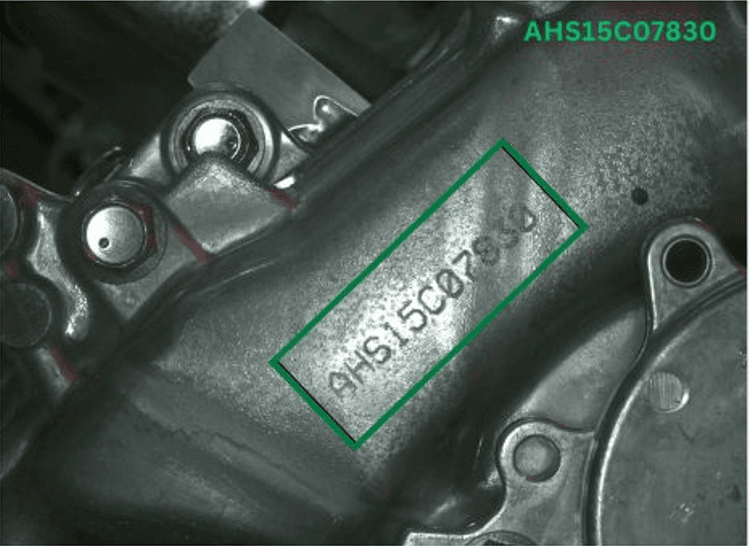
Industrial-grade cameras positioned around the inspection station captured high-resolution images of predefined Regions of Interest (ROIs) containing serial numbers, batch codes, laser-etched markings, engraved text, printed labels, or Data Matrix codes present on critical engine components.
Instead of analysing the complete image, Cognivision focused only on configured inspection regions, improving inspection speed while maintaining high recognition accuracy. The AI-powered OCR engine extracted and interpreted identification data regardless of variations in font style, engraving depth, lighting conditions, surface texture, or component orientation.
The extracted information was immediately validated against production records to confirm that the correct component had been installed on the corresponding engine. Any missing, incorrect, unreadable, or mismatched identification was instantly flagged for operator review before the engine progressed further through production.
Once validation was successfully completed, every identified component was automatically linked to the engine ID, creating a permanent digital traceability record containing captured images, extracted text, inspection timestamps, validation results, and production information.
The project began with a comprehensive assessment of the customer's engine assembly process to identify all traceability checkpoints and components requiring automated identification.
Citriot engineers collaborated with the customer's manufacturing and quality assurance teams to determine which serial numbers, part numbers, laser markings, and identification labels needed to be inspected throughout the production cycle. Based on this analysis, industrial cameras were strategically installed at key inspection stations where components could be captured without interrupting production flow.
The OCR models were then trained using thousands of production images representing engraved, stamped, laser-marked, and printed identification formats commonly found across different engine components. This enabled the AI to accurately recognize markings despite differences in size, contrast, orientation, surface finish, or manufacturing variations.
Following validation, Cognivision was integrated with the customer's Manufacturing Execution System (MES), RFID infrastructure, and barcode scanners. Every engine entering the inspection station automatically initiated the identification process, allowing all captured component information to be validated and linked directly to the engine's production record in real time.
The complete inspection history, including images, extracted text, validation status, timestamps, engine ID, and operator details, was securely stored in a centralized database, providing end-to-end traceability for every manufactured engine.
Following the deployment of Cognivision, the manufacturer significantly improved both the accuracy and efficiency of its traceability process. Manual recording of component information was eliminated, reducing transcription errors while accelerating production throughput.
The AI-powered OCR system consistently identified serial numbers, batch codes, and laser-etched markings that were previously difficult to read during manual inspection. Incorrect or missing components were detected immediately, preventing traceability issues from progressing further into the manufacturing process.
The organization also established complete digital traceability for every engine produced. Every component installed during assembly could now be traced instantly through a centralized inspection database, enabling faster quality investigations, simplified warranty analysis, improved recall management, and streamlined regulatory compliance.
The implementation of Cognivision transformed the manufacturer's traceability process from a manual documentation activity into an intelligent, fully automated digital inspection system.
The organization achieved complete end-to-end traceability across its engine production line while significantly reducing operator dependency, manual data entry errors, and inspection time. Automated validation improved manufacturing quality by ensuring that every engine was assembled using verified components that matched production specifications.
The availability of comprehensive digital inspection records also strengthened regulatory compliance, simplified quality audits, accelerated warranty investigations, and enabled management to make better manufacturing decisions using real-time production data.
This implementation demonstrates how Artificial Intelligence, industrial vision systems, and advanced OCR technology can modernize manufacturing traceability. By automating component identification, validating production information in real time, and digitally linking every inspected component to its corresponding engine, Cognivision enabled the manufacturer to improve production efficiency, eliminate identification errors, strengthen quality assurance, and establish a fully traceable manufacturing process capable of supporting large-scale production with confidence.