A leading engine manufacturer producing high volumes of industrial and automotive engines wanted to strengthen its end-of-line quality inspection process. Every engine assembled on the production line contained dozens of mechanical and electrical components that had to be installed correctly before the engine could proceed to testing or shipment. Even a single missing cap, incorrectly positioned connector, wrong bracket, misplaced hose clip, or incorrect component variant could result in product failures, costly rework, warranty claims, and customer dissatisfaction.
The manufacturer relied primarily on manual visual inspection performed by quality operators to verify engine assemblies. As production volumes increased and engine designs became more complex, maintaining consistent inspection quality became increasingly difficult. To eliminate human dependency and establish a standardized inspection process, the organization partnered with Citriot to deploy **Cognivision**, an AI-powered multi-camera engine assembly inspection system capable of validating complete engine assemblies in real time.
The customer's production line assembled thousands of engines every month, with each engine containing numerous components sourced from different manufacturing processes. Every component needed to be present, correctly positioned, securely assembled, and matched with the appropriate product variant before the engine could be approved for dispatch.
Manual inspection required operators to visually examine multiple sides of every engine while checking for missing components, incorrect assembly, damaged parts, and variant mismatches. This process was time-consuming and heavily dependent on operator experience, resulting in inconsistent inspection quality across production shifts.
As production speed increased, inspectors had limited time to examine every engine thoroughly. Minor assembly defects such as missing fasteners, disconnected sensors, incorrectly installed brackets, misplaced hose clips, or wrong component variants could occasionally remain undetected until later production stages or even after delivery to customers.
The manufacturer also lacked comprehensive digital inspection evidence, making quality investigations, warranty analysis, and regulatory audits more difficult. They required an automated inspection solution capable of inspecting every critical engine component consistently while maintaining production speed and providing complete digital traceability.
Citriot implemented **Cognivision**, an AI-powered computer vision platform designed specifically for automated engine assembly verification.
Multiple industrial-grade cameras were strategically positioned around the inspection station to capture synchronized high-resolution images of the engine from multiple viewpoints. Each camera was assigned specific inspection zones, ensuring complete visibility of every critical assembly area without blind spots.
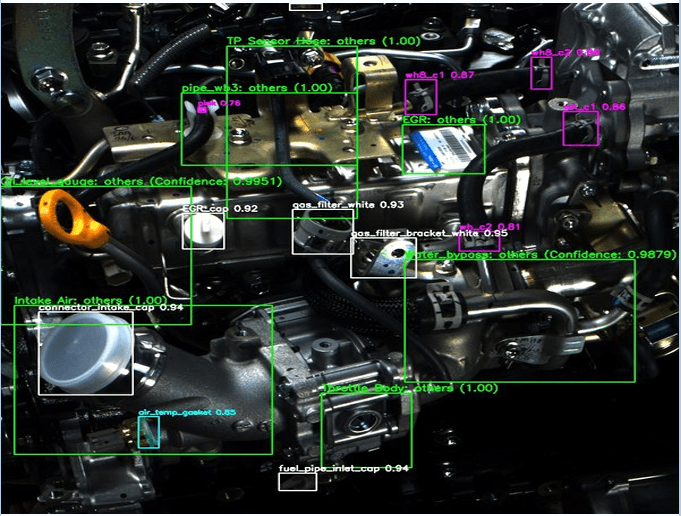
As an assembled engine entered the inspection station, all cameras simultaneously captured images within a fraction of a second, eliminating the need for manual repositioning or multiple inspection stages. These images were immediately processed using advanced artificial intelligence models trained to recognize engine components, verify their presence, identify their correct position and orientation, and confirm that the installed component matched the required production variant.
Rather than simply identifying whether a component existed, Cognivision evaluated the complete assembly against predefined manufacturing standards. The AI verified sensors, connectors, brackets, hose clips, fuel pipes, labels, caps, cooling system components, gaskets, turbo assemblies, fasteners, and other critical engine parts to ensure every component was installed correctly.
The inspection results from all cameras were combined into a single quality assessment. If every inspection criterion was satisfied, the engine automatically received a **Pass** status and continued through the production process. If any missing component, assembly deviation, incorrect orientation, or variant mismatch was detected, the engine was immediately classified as **No Good (NG)**, allowing corrective action before the engine progressed further through production.
The implementation began with a detailed study of the customer's engine assembly process, quality checkpoints, and historical defect records. Citriot engineers worked closely with manufacturing and quality assurance teams to identify every critical component requiring automated inspection and define acceptance criteria for each inspection point.
Following the assessment, multiple industrial cameras were installed around the inspection station and carefully calibrated to provide complete coverage of all engine faces while eliminating blind spots. Dedicated lighting systems were introduced to ensure consistent image quality regardless of factory lighting conditions.
The Cognivision AI models were trained using thousands of production images representing correctly assembled engines as well as multiple defect scenarios, including missing components, incorrect variants, improper positioning, assembly deviations, and installation errors. This extensive training enabled the AI to accurately distinguish acceptable assemblies from defective ones across different engine models and production batches.
Once validated, the inspection platform was integrated with the customer's Manufacturing Execution System (MES), allowing every engine entering the inspection station to be automatically identified and inspected without operator intervention. Inspection results, annotated images, component-level verification data, timestamps, engine identification, and quality status were securely stored in a centralized database, creating a permanent digital inspection history for every engine manufactured.
Following the deployment of Cognivision, the manufacturer significantly improved the consistency, speed, and accuracy of its end-of-line quality inspection process. Every engine produced on the assembly line was inspected using the same standardized validation procedure, eliminating variations caused by operator judgement or production shift changes.
The AI-powered inspection system successfully identified missing components, incorrect installations, and variant mismatches before engines progressed to downstream processes, preventing costly rework and reducing the likelihood of defective products reaching customers.
Inspection cycle times were reduced while maintaining complete inspection coverage, enabling higher production throughput without compromising product quality. The manufacturer also established complete digital traceability for every inspected engine, allowing quality teams to retrieve inspection images, component verification results, and production records instantly during audits, warranty investigations, or root cause analysis.
The implementation of Cognivision transformed the customer's end-of-line inspection process from manual quality verification into an intelligent, AI-driven automated quality assurance system.
The organization achieved consistent inspection quality across all production shifts, significantly reduced assembly-related defects, minimized rework and warranty costs, and strengthened overall manufacturing reliability. Automated inspection also improved production efficiency by reducing inspection time while maintaining comprehensive quality validation for every engine produced.
The availability of complete digital inspection records enhanced regulatory compliance, simplified quality audits, accelerated warranty investigations, and provided valuable production analytics that supported continuous process improvement across the manufacturing facility.
This implementation demonstrates how Artificial Intelligence and industrial computer vision can modernize complex engine assembly inspection. By combining synchronized multi-camera imaging, deep learning-based component verification, automated pass/fail decision-making, and comprehensive digital traceability, Cognivision enabled the manufacturer to establish a faster, more reliable, and fully standardized quality inspection process. The solution not only improved product quality and operational efficiency but also provided the confidence that every engine leaving the production line met the highest manufacturing standards.